Monday, 13 December 2021

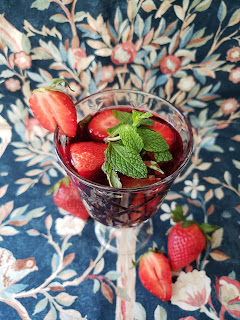
Three Strawberry Thief Cocktails/Mocktails


1. STrAWBERRY BOURBON SMASH


INGREDIENTS

3 medium strawberries

1-2 tsp (4-8 g) sugar

6 fresh mint leaves, torn, plus more for garnish

1.5 oz (43 ml) Bourbon* 
*Replace with pomegranate juice for a mocktail*

1/2 oz Grenadine

1 tbsp (15 ml) fresh lemon juice

1/4 tsp dark balsamic (or 2 dashes of Angostura bitters)

Ice


METHOD

In a rocks glass muddle the strawberries and sugar together, fill the glass with ice (or use whole frozen strawberries).

In a large cocktail shaker, add the torn mint leaves, bourbon, grenadine, lemon juice and balsamic.  Fill the shaker with ice.  Shake well and strain into the glass.  Garnish with fresh mint sprigs.  Enjoy!


***
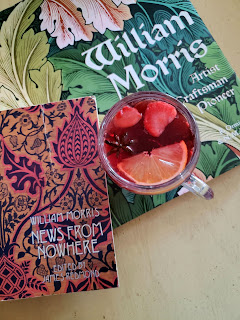


2. STrAWBERRY Holiday Mulled Wine


INGREDIENTS

1 bottle of red wine*, recommended Cabernet Sauvignon or Merlot
*Replace with non alcoholic wine or fruit juice of choice for a non-alcoholic alternative*

2 cups of pure apple cider

1/4 cup of pure maple syrup OR honey
*Omit if using a sweetened juice for a non-alcoholic alternative*

3 whole cloves

Peel of 2 small oranges or 1 large one

Handful of orange slices (for garnish)

2 cinnamon sticks

1 star anise pod

1/4 cup of brandy

1 cup of sliced frozen strawberries


METHOD

Combine all ingredients into a stockpot set over medium heat, do not boil or the alcohol in the wine will evaporate completely. 

Bring to a low simmer and heat for about 20 mins while stirring often. Lower the heat and allow it to cool slightly before loading it into mugs or heat-proof glasses.

Garnish it with a cinnamon stick, additional orange slices and some more frozen strawberries before serving.


***


3. sparkling STRAWBERRY THIEF 

INGREDIENTS

1 bottle of Champagne*
*Replace with ginger ale or sparkling beverage of choice for a non-alcoholic alternative*

1 cup strawberries, fresh or frozen

2 Tbsp sugar

juice of 1 lime or 1/4 cup passionfruit juice

2-4 strawberries for garnish


METHOD

If you're using frozen strawberries, defrost them. Mash or macerate the strawberries with the sugar. Add the lime/passionfruit juice to the puree.

Place 1-2 tablespoons of the puree at the bottom of your glass and top with Champagne or sparkling beverage of choice. Garnish with strawberries, whole or sliced.


Monday, 6 December 2021

WMSC Zoom Holiday Cocktail Hour


WMSC Zoom Holiday Cocktail Hour!

Celebrate the 40th anniversary of the WMSC!

Wednesday December 15th, 2021 at 5:30 - 6:30 pm EST
Members only Zoom Event 


Have a "Strawberry Thief" recipe to share?


We’ll walk down memory lane to look at the early days of the WMSC, and the great WMSC trips over the years. We will also have some small group breakout rooms for chats, which people enjoyed last year.


You’re encouraged to wear your Morris/Liberty finery, or whatever else makes you feel special. 


As it’s a cocktail hour, we ask you “what would Morris drink”? If people have some ideas for creative cocktails, please email us beforehand and we'll share them with the group. We’ve already had the suggestion of “Strawberry Thief”, recipe still to be determined.


We’ll have a toast, so be prepared with something you’d like to sip on, whether it’s a cocktail, glass of wine or cuppa tea.


Tuesday, 2 November 2021

The Dragon and the Smith: William Morris, JRR Tolkien and the Legend of Sigurd the Volsung


The Dragon and the Smith:
William Morris, JRR Tolkien and the Legend of Sigurd the Volsung

An illustrated lecture by Dustin Geeraert, U. of Manitoba

Monday, November 15th, 2021 at 7:30 pm EST
Zoom Event 


William Morris, Kelmscott Press. "Sigurd the Volsung".

In the 1860s William Morris and the London-based Icelander Eiríkur Magnússon began translating Icelandic sagas into English. They soon published the first ever translation of Völsunga saga, as The Story of the Volsungs and Niblungs, with Certain Songs from the Elder Edda, in 1870. This archetypal Norse dragon-slayer dragon-slayer legend inspired a range of later poems, prose tales, and articles by William Morris and by his successor in Norse-inspired medievalism, J. R. R. Tolkien. Both medievalists immersed themselves deeply in the Norse legacy of Eddas and Sagas, and in response cultivated a Romantic philosophy of craftsmanship. In their various versions of the Volsung legend two figures stood in stark contrast in the roles of creator and destroyer: the Dragon and the Smith.

Dustin Geeraert teaches literature in the English and Icelandic departments at the University of Manitoba. He is editor of ‘The Modern Reception of the Medieval Saga of the Sworn Brothers’ (Scandinavian-Canadian Studies 26, 2019) and The Shadow Over Portage and Main: Weird Fictions (2016, with Keith Cadieux), and has published articles in Journal of the William Morris Society (2012), The Lovecraft Annual (2014), Comitatus: A Journal of Medieval and Renaissance Studies (2018), and From Iceland to the Americas: Vinland and Historical Imagination (2020).

Wednesday, 20 October 2021

Young Poland: An Arts and Crafts Movement (1890 – 1918)


Young Poland:
An Arts and Crafts Movement 
(1890 – 1918)


October 9 2021 – 30 January 2022
William Morris Gallery, London


Curated by Julia Griffin, Andrzej Szczerski and Roisin Inglesby


For those that can't make it to see the exhibition in person, see the website here for more Polish Arts & Crafts: https://youngpolandartsandcrafts.org.uk/exhibition/


Thursday, 30 September 2021

Lecture: Young Poland: The Polish Arts and Crafts Movement

 Young Poland: The Polish Arts and Crafts Movement
An illustrated lecture by Julia Griffin

Sunday, October 3rd, 2021 at 2:00 pm EST
Zoom Event open to all!
*Please note only WMSC members will receive a link to the AGM

Karol Kłosowski, At Bobbin Lacemaking (Legend), undated. Private Collection. By Descent from the Artist


The Young Poland movement emerged in the 1890s in response to Poland’s non-existence for almost a century. From the end of the 18th-century Poland underwent successive partitions dividing the country between Russia, Austria and Prussia, resulting in the country disappearing from the map of Europe for 123 years. In the words of historian Norman Davies, Poland became “just an idea – a memory from the past or a hope for the future”. With the failure of military uprisings, culture became a means to preserve an endangered national identity.

The movement originated under the more liberal Austrian partition known as Galicia, namely in Kraków and the nearby village of Zakopane at the foot of the Tatra Mountains, and soon spread across the nation. It embraced an unprecedented flourishing of applied arts and the revival of crafts, drawing inspiration from nature, history, peasant traditions and craftsmanship to convey patriotic values. While the diverse visual language of Young Poland was created autonomously, in search of a distinctive cultural style and identity, it simultaneously looked outwards to Britain and the rest of Europe.

The first part of the October 3rd lecture will chart the artistic achievements of Stanislaw Wyspianski (1869–1907), arguably the greatest design reformer in Poland’s history, who was William Morris’s closest counterpart. The two artists came from different generations and never met. However, they had a lot in common in terms of their reformist outlook, remarkable creative versatility as applied arts designers and interior decorators, shared interests, commitment to similar causes, and last but not least their character traits and work ethic. As J.W. Mackail, the author of Morris’s first official biography The Life (1899), perceptively stated, Morris’s two greatest inspirations were history and nature; the same was true for Wyspianski. In fact, Wyspianski’s ‘intention was to play the same role in Poland as Morris did in England.’

The second part of the lecture will illuminate Karol Klosowski (1882–1971), a Polish Arts and Crafts designer with a Morrisean genius for ornament. Klosowski’s charming repeating patterns of animals, birds, insects and plants were his means of practising cultural democracy. He stated: ‘pragmatism only serves the sustenance of a vegetative form of human existence. It is beauty which gives life fullness, dignity and worth.’ Unlike Wyspianski, who lived in the city of Kraków, Klosowski chose to settle down in the village of Zakopane, at Silent Villa, where he led the sort of quiet rural existence that Morris longed for but could never experience at Kelmscott due to pressing duties in London.

Julia Griffin is academic co-editor of 'Young Poland: The Polish Arts and Crafts Movement, 1890–1918' and co-curator, with Andrzej Szczerski and Roisin Inglesby, of the exhibition of the same name at the William Morris Gallery (9 October 2021 to 30 January 2022). Julia is a Courtauld-trained art historian specialising in British art, design and cultural history. Her PhD explores Rossetti, Morris and the cultural place-making of Kelmscott Manor. Previous roles include Principal Curator of Guildhall Art Gallery, City of London, Collections Manager of the Society of Antiquaries and Assistant Curator of Watts Gallery.

Thursday, 23 September 2021

Museum of the American Arts and Crafts Movement

Museum of the American Arts and Crafts Movement opens in St Petersburg, Florida.

The Museum of the American Arts and Crafts Movement opened to the public Sept. 7, 2021.

Founded by collector Rudy Ciccarello, more than 800 works collected personally by Ciccarello are showcased, culled in part from the Two Red Roses Foundation.

Wednesday, 18 August 2021

People Tree and V&A Morris-inspired collaboration


The latest collaboration with the Victoria & Albert museum celebrates the beauty of prints and patterns that so inspired designers such as William Morris. 


Based on a pretty wallpaper from 1896 by John Henry Dearle, this pattern is reminiscent of many of Morris & Co.'s early designs with its simple meadow flowers and structure of climbing foliage.


See the recent collection here:

People Tree is a Fair Trade clothing company. In the spirit of Morris' socialist and environmental concerns, this brand champions craftspeople and holds itself to a high ethical standard. From their website:

Our Mission:
To support producer partners' efforts towards economic independence and control over their environment and to challenge the power structures that undermine their rights to a livelihood. 

To protect the environment and use natural resources suitably throughout our trading and to promote environmentally responsible initiatives to create new models to promote sustainability. 

To supply customers with good quality products, with friendly and efficient service and build awareness to empower customers and producers to participate in Fair Trade and environmentally sustainable solutions. 

To provide a supportive environment to all stakeholders and promote dialogue and understanding between them. 

To set an example to business and government of a Fair Trade model of business based on partnership, people-centered values and sustainability.